From confusion to clarity: Rising Scholars helps Ethiopian researcher build a winning grant team
Interview and article written by Aastha Subedi, Rising Scholars Community Administrator
In the rapidly evolving landscape of higher education, researchers in the Global South are often best positioned to tackle the ethical and practical questions raised by new technologies – but the path from research idea to funded project can feel like a “black box” of unclear requirements and uncertain outcomes. Rising Scholars, hosted by INASP, helps demystify this process, giving early career researchers the confidence and collaborative tools they need to secure funding and lead change within their own institutions.
The transformation: beyond “working with friends”
For Tigist Tajebe Wakjira, a researcher at Jimma University in Ethiopia, the path to securing a research grant was once defined by hesitation and unclear roles.
“Before training, we had the same challenge,” Tigist reflects. “Team formulation was unclear, there were no clear roles… and the key parts, like methodology and the impacts, felt confusing”.
Tigist’s previous research teams had often been built on proximity – colleagues who were friends, or from the same department. An INASP/Rising Scholars Grant Proposal Writing workshop she attended introduced a different way of thinking about team structure: moving from “friendship-based” teams toward “duty-based” collaboration, selecting the right person for the right role. To put this into practice, Tigist’s team approached an e-learning expert during the training, specifically because the project demanded his technological expertise.
“Successful grant writing is not just about writing… It requires strong teamwork, a clear strategy, and effective use of limited resources. It’s not about making a friendship; it’s about formulating the right person for the right duties.”
Tigist Tajebe Wakjira
The mission: reimagining education through AI
The collaboration led to a successful grant from Jimma University for a project examining the integration of Artificial Intelligence (AI) into educational quality, creativity, and critical thinking.
The work spans Ethiopia’s “first-generation” universities, including Addis Ababa, Hawassa, and Jimma University, aiming to bridge technological gaps while addressing the ethical implications of AI in the classroom, and generate evidence-based recommendations and policy directives, for teachers, students, and institutional leaders alike. Tigist refers to these first-generation institutions as “champions” because they possess the infrastructure to pilot these AI ethics first, creating a trickle-down effect for the rest of the country.
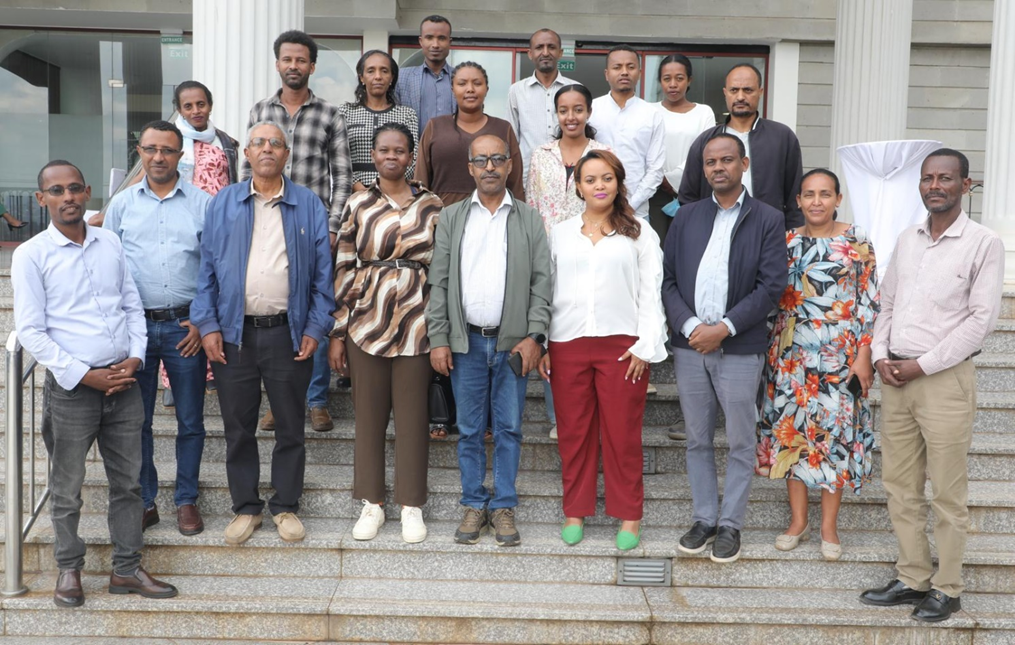
Jimma University grant proposal writing workshop participants and facilitators
Innovation on a shoestring: the “budget hack”
When Jimma University offered a more limited budget than the team had expected, they applied a lesson from the workshop: treating a small budget as a seed for larger impact.
They moved away from costly in-person data collection to a digital approach, using Google Docs and digital case scenarios to collaborate across universities without high travel costs.
“We were not hesitant to accept that [budget],” Tigist explains. “We developed different strategies for how to manage this proposal with this limited fund… this is what we get from the training”.
Looking ahead
Tigist is clear that winning the grant was only the beginning. The “post-award” phase – navigating university bureaucracy to access funds and managing a project within a strict budget – has been a distinct and difficult hurdle. “It’s beyond the theory,” she explains, describing how the real work of administrative management began once the funding was confirmed. Looking back, Tigist suggested that Rising Scholars could expand its focus to include post-award management training, helping researchers prepare for the practical realities of project execution. This is something INASP is currently working on.
Tigist remained fully engaged in the intensive training even in the final weeks of pregnancy, never arriving late to the long workshop days. Today, her department has a renewed sense of collaboration, and the success of the grant has given her team the confidence to mentor colleagues and pursue larger international grants in the future.
Impact through Rising Scholars
- Advancing locally relevant knowledge: Through Rising Scholars, researchers like Tigist are equipped to generate critical evidence on the ethical use of AI, ensuring that technological integration in Ethiopian higher education is grounded in contextual needs.
- Strengthening research leadership: INASP’s training supported Tigist’s team and many other researchers turn an unclear process into a clear strategy for success, securing their first grant and building a culture of interdisciplinary collaboration.
- Building institutional resilience: Rising Scholars has a history of finding new ways to bridge the learning gap for early career researchers – equipping researchers like Tigist to deliver high-quality results even when resources are limited.
 Previous Post