
Making research communication more equitable and effective: six levers to support preprint sharing
Haseeb Md. Irfanullah and Alice Chadwick El-Ali
The current research publishing system is failing both science and society. Enormous sums are spent on Article Processing Charges (APCs); inequalities in who can publish remain deeply entrenched; and access restrictions combined with publication delays limit who can benefit from new evidence.
Preprints, research articles uploaded to a public server before peer review, offer a practical path forward. They enable the earliest possible access to evidence and remove cost barriers providing an equitable alternative to pay-to-publish models. Yet while most policymakers and research funders are committed to Open Access, many have not recognised preprint sharing as a key solution to the failures of the current publishing system. INASP’s new policy paper sets out six levers to help policymakers and research funders support preprint sharing and drive change in the research publishing system.
Why should research funders and policymakers care about preprint sharing?
Immediate access: Preprints bypass the delays of journal publication, getting research into the world faster. Ensuring quick and free access to new research is not only an academic issue, but also vital for ensuring the latest evidence informs policy and practice and drives transparency and public support for science. The role of preprints during the COVID-19 pandemic demonstrated the value of this speed. The on-going Ebola outbreak in Democratic Republic of the Congo (DRC) and Uganda offers another compelling case for rapid sharing of evidence.
Equitable participation: Preprints give researchers a way to share work openly at no cost, offering an equitable alternative to pay-to-publish models. For researchers, especially early career and Global South scholars, preprints establish priority of work and enable recognition without waiting on journal publication timelines.
Cost-effectiveness: Recognising preprint sharing as a route to Open Access compliance could significantly reduce the APC burden on research funders. Those savings can be reinvested in research itself and in community-owned publishing infrastructure. This will ensure value for money from public funds and ensure the sustainability of open infrastructure preventing commercial capture.
Transparency and research integrity: Preprints shift scrutiny from a closed pre-publication process to a transparent post-uploading one. This challenges the flawed assumption that prestige journal publication equals quality and creates stronger incentives for integrity throughout the entire research process.
Funders and policymakers who recognise these benefits of preprint sharing can be guided by the six levers in our latest policy paper.
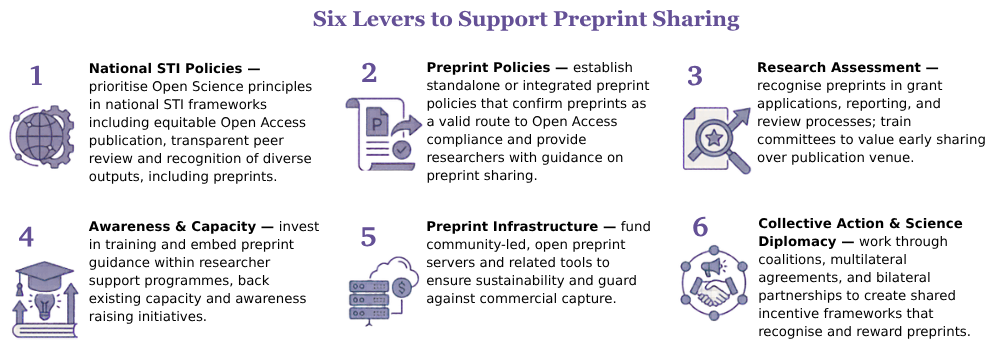
These levers are mutually reinforcing, working together to enhance recognition of preprints and support preprint sharing amongst the research community. Whilst national Science Technology and Innovation (STI) policy interventions (Lever 1) consider preprints as part of a broader drive for Open Science within national research ecosystems, preprint-specific policies (Lever 2) address the requirements for preprint sharing within funder policy e.g., licensing, submission timelines, funder acknowledgement, and data availability.
Reforming the research assessment system (Lever 3) ensures preprints are recognised as a research output shaping funding and career incentives. Wider awareness and capacity strengthening (Lever 4) driven by the research community is vital to support culture change. But more widespread uptake of preprint sharing will only be possible through sustained support for community-led preprint infrastructure (Lever 5). Concurrently, global science diplomacy (Lever 6) is essential for ensuring high-level attention to preprints within global scientific collaboration.
No single funder or government can shift global publication norms alone. Collective action through Open Science coalitions, reforms to research assessment, targeted investment in infrastructure, and science diplomacy is essential. Research funders can adopt or update preprint policies, recognise preprints in research assessment frameworks, and invest in equitable, community-owned preprint infrastructure. Policymakers can embed Open Science commitments in national STI strategies and champion preprints and Open Science in bilateral and multilateral dialogue. Together, these six levers can support preprint sharing and equitable research access.
Read out latest policy paper and our editorial in the International Science Council’s Open Science round-up on making preprints count.
Image by Resource Database on Unsplash
 Previous Post
 Next Post